Week 1: TWO CULTURES
Week 1: TWO CULTURES
After going through the readings and lectures, I spent some time analyzing the two cultures present in my immediate world, especially regarding my experiences on the UCLA campus. In C.P. Snow's article, he introduces the two cultures: literary intellectuals (representing the humanities) and scientists, which they are often operate in isolation from each other with little mutual understanding or interaction.
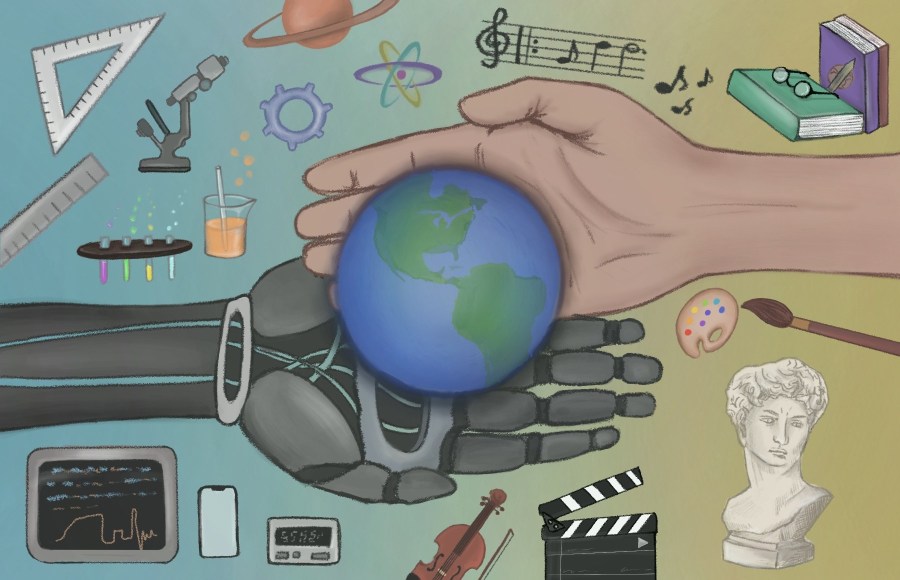 |
| STEM & Humanities |
As a Gender Studies major and Film minor student, I have predominantly remained in the North Campus area and rarely go to the South Campus. My only experience attending a class in a STEM building was a Disability Studies class taking place in Boelter Hall, and it was different from the familiar North Campus. The pace here was very fast, and the buildings were plastered with academic posters, mostly populated by students. In contrast, the North Campus has more open spaces and lawns, and people from outside the campus walk dogs and do yoga here. Just as Justin Jung mentioned in the article, although there are no physical barriers between these two campuses, you immediately notice a change in atmosphere when you cross the invisible boundary.
 |
| North Campus & South Campus |
This alienation contributes to common stereotypes about these two fields; for example, the perception that a literature major's atmosphere and knowledge have limited career prospects, while STEM majors have greater income potential upon graduation. However, the existence of the third culture concept, as illuminated by Professor Victoria Vesna, challenges the foundation of these stereotypes about the two cultures. Individuals' lives involve more than just careers and financial pursuits. It is important to recognize how intersecting forms of oppression, such as racism, sexism, and ableism, contribute to shaping a better and more inclusive society.
Chow, Jin. “Myth or Fact?: STEM Majors Are Inherently More Valuable than Humanities Majors.” Forbes, Forbes Magazine, 27 Oct. 2023, www.forbes.com/sites/jinchow/2023/10/26/myth-or-fact-stem-majors-are-inherently-more-valuable-than-humanities-majors/?sh=6967a7ce3606.
Jung, Justin. “A Campus Divided.” PRIME, 2021, prime.dailybruin.com/justinnorth&southcampus.
Snow, C. P. “The Two Cultures.” The Two Cultures and the Scientific Revolution, Cambridge University Press, 1961, pp. 1–58.
Vesna, Victoria. “Toward a third culture: Being in between.” Leonardo, vol. 34, no. 2, Apr. 2001, pp. 121–125, https://doi.org/10.1162/002409401750184672.
Watchler, Hilary. “What Can I Do with a Gender Studies Major?” Gender Studies, 9 July 2019, gender.ucla.edu/undergraduate/what-can-i-do-with-a-gender-studies-major/.
Images/Video:
Last-Bernal, Natasha. “The Value of the Humanities in a Stem Obsessed World.” Highland Piper, 8 Mar. 2021, highlandpiper-sc.com/1817/interest/the-value-of-the-humanities-in-a-stem-obsessed-world/.
Tak, Nitya “A Campus Divided.” PRIME, 2021, prime.dailybruin.com/justinnorth&southcampus.
“What Is Intersectionality?” YouTube, Center for Prevention MN, 21 Feb. 2021, www.youtube.com/watch?v=-885E7gqVB4.


Hi Jingshuai, this is a great blog post analyzing your personal experiences as a mostly north campus major and what ways to consider the two cultures that are present in today's society. I definitely agree about how there are so many different stereotypes that exists within each individual major, but also the general category that they are in. It is unfortunate especially with humanities-related majors that they are associated with a lower pay or considered not as useful. However, even though there is this clash between the two cultures I believe that one has to exist for the other to exist as well. So despite the fact that humanities majors are viewed in a worse light than STEM majors in society, I believe that it is viewed this way because there is this comparison. However, ultimately they both are equally as important in helping society be whole and well-rounded. This can serve others as needed too as you mentioned.
ReplyDelete